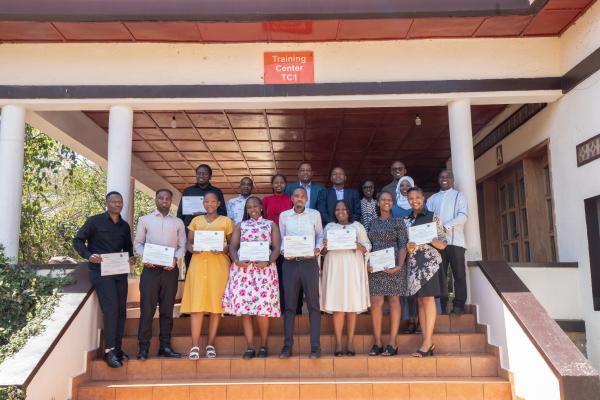
Eleven nurses and midwives from hospitals and health centers across Kirehe, Kayonza, and Burera districts, were formally recognized on August 12, 2026, after completing a six-month competency-based training in obstetric ultrasound at the Rwinkwavu Ultrasound Training Centre in Kayonza District. The training combined classroom instruction with supervised practical sessions to strengthen the healthcare providers’ ability to use ultrasound in pregnancy care.
The Rwinkwavu Ultrasound Training Centre was initiated by Partners In Health/Inshuti Mu Buzima (PIH/IMB) in collaboration with the Department of Medical Imaging Sciences at the University of Rwanda’s College of Medicine and Health Sciences to build capacity in ultrasound for healthcare providers. The inaugural cohort began its training in November 2025 and concluded in May 2026; it consists of nurses and midwives from three districts where PIH/IMB operates.
Dr. Erick Baganizi, Head of Division for Clinical Programs at PIH/IMB, said the training was designed to address a gap that emerged after health centers received obstetric ultrasound machines. Although some nurses and midwives received seven days of training, the short duration was insufficient to build the skills needed to use the equipment confidently, and some machines remained idle. PIH/IMB therefore introduced the six-month program to equip midwife mentors with deeper theoretical and practical skills that they can apply in patient care and share with colleagues at their health centers.
Speaking on behalf of the graduates, Odeth Mbabazi, a nurse at Kabarondo Health Center in Kayonza District, described the training as transformative. She noted that she is now fully confident using obstetric ultrasound equipment and has already integrated it into her daily patient care.
“I came here with zero knowledge about using obstetric ultrasound; it was my first time touching the machine. But after the training, I am able to use it, accurately interpret the images, and apply it to my daily work,” she added.
This initiative was implemented in partnership with the University of Rwanda (UR), which provided facilitators to guide trainees over the six-month program.
Dr. Emmanuel Odumeru, a lecturer at the University of Rwanda’s College of Medicine and Health Sciences and one of the facilitators, said the trainees entered the program with limited knowledge of obstetric ultrasound but demonstrated substantial improvement by the end of the training.
“The programme was rigorous, not only in content but also in its assessment strategy, which ensured that learners achieved proficiency through multiple dimensions of evaluation. This multi-layered assessment ensured that graduates were not only knowledgeable but also clinically competent, reflective, and capable of integrating ultrasound into patient management,” he added.
“Over this period, we observed progressive improvement in their competencies, a testament to their dedication and the guidance of our facilitators.”
The obstetric ultrasound program is part of PIH/IMB’s broader efforts to strengthen medical imaging capacity within Rwanda’s health system. Echocardiography training is currently underway, while breast ultrasound training is planned as the organization continues expanding specialized training for healthcare providers.